ByJohn A
Why Mechanical Testing Is Essential for Modern Manufacturing
Mechanical testing plays a central role in modern manufacturing because it helps engineers understand how materials and finished products behave under real-world forces. Every component, from a small fastener to a large structural beam, must be capable of performing safely and consistently throughout its expected service life. Mechanical testing provides measurable data about strength, hardness, toughness, elasticity, fatigue resistance, and other physical characteristics that influence performance.
One of the main purposes of mechanical testing is to verify whether a material can withstand the stresses it will experience during use. A manufacturer may select steel, aluminum, polymers, composites, or other materials based on their expected properties, but assumptions are not enough. Testing confirms whether the actual material delivered to a production facility meets the required specification. This is especially important when raw materials come from different suppliers or when a manufacturing process can change material behavior.
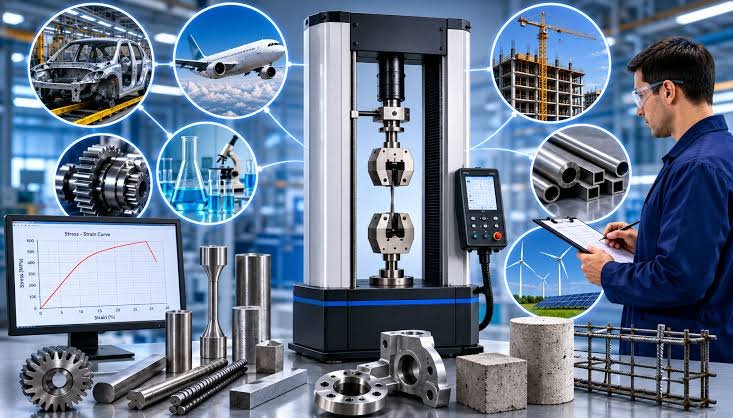
Tensile testing is one of the most common forms of mechanical testing. During this process, a sample is pulled until it deforms or breaks. The results can reveal tensile strength, yield strength, elongation, and other important properties. Engineers use this information to decide whether a material is suitable for applications where pulling or stretching forces are common. For example, cables, structural members, and machine parts may all require specific tensile characteristics.
Hardness testing is another important method. It measures a material’s resistance to indentation or surface deformation. Hardness can be closely related to wear resistance, which makes the test useful for gears, tools, bearings, and many other components. Different hardness methods may be used depending on the material and the required level of precision.
Impact and toughness testing help determine how materials respond to sudden loads. A component that performs well under a slow and steady force may behave very differently when subjected to a rapid shock. This is why mechanical testing is necessary in industries such as transportation, construction, energy, and heavy machinery. Materials used in these sectors may need to absorb significant energy without cracking or failing unexpectedly.
Fatigue testing is also critical because many parts fail after repeated loading rather than one extreme event. A rotating shaft, aircraft component, suspension system, or industrial spring may experience thousands or even millions of load cycles. Fatigue testing helps engineers estimate how long a component can continue operating before cracks begin to form. This information supports better design choices and safer maintenance schedules.
Read Also: LED Outdoor Signage Ideas to Enhance Your Business Presence
Mechanical testing also contributes directly to quality control. Manufacturers can test samples from production batches to confirm that processes remain stable. If test results begin to move outside acceptable limits, the company can investigate potential issues with heat treatment, machining, forming, welding, raw material quality, or other production variables. Detecting these problems early reduces waste and prevents defective products from reaching customers.
Another major benefit is regulatory and standards compliance. Many industries require materials and products to meet recognized national or international standards. Mechanical testing provides documented evidence that specific requirements have been satisfied. This documentation may be required for certification, customer approval, audits, or safety-related applications.
The data generated by mechanical testing can also support product development. Engineers can compare different materials, coatings, manufacturing methods, and design options before making final decisions. By testing prototypes and samples, they can identify weaknesses early and improve performance before full-scale production begins. This reduces the risk of expensive redesigns later.
Mechanical testing is therefore much more than a laboratory activity. It is a practical tool that connects material science, engineering design, manufacturing quality, safety, and long-term reliability. Companies that use testing effectively can make better material choices, improve consistency, reduce failures, and build greater confidence in their products. As manufacturing becomes more advanced and performance expectations continue to rise, mechanical testing will remain an essential part of producing safe, durable, and dependable components.