
ByJohn A
Why Technical SEO Still Gets Overlooked by Small Businesses
Small businesses often overlook technical SEO because it works behind the scenes. Instead, they focus on visible marketing tasks like investing in content, keyword research, and digital marketing. All without realising that search engines might not be reading their site properly in the first place.
Not to mention, things like slow page load time, indexing gaps, and missing structured data rarely show up in a content audit. They show up when rankings plateau for no obvious reason. At Matter Solutions, we often find these technical SEO issues sitting silently behind stalled rankings.
In this article, we’ll share why small businesses tend to overlook these problems, and what to fix first. So, grab a cup and take a sip.
Is SEO Really Just About Keywords and Content?

Not at all; search engine optimisation covers a lot more ground beyond keywords and website content. In fact, the technical layer underneath is mostly what decides whether any of that SEO work ever reaches search results.
You might be surprised how often this confusion comes up, even in businesses already running an active SEO campaign with a full team behind them.
Here are five reasons small businesses skip technical SEO entirely:
- What Your Developer Probably Didn’t Do: Web developers build sites for appearance and function, rather than crawlability. A technical audit is a separate process, and most web developers don’t run one after launch. Because of that, issues sit undetected from day one.
- Why Content Alone Won’t Cut It: Traditional SEO and keyword research get most of the attention, and understandably so. That said, search engines need way more signals than web content alone before they rank existing pages on a site.
- Cost Isn’t the Real Barrier: Most small business owners assume only a large, expensive agency with deep SEO expertise handles technical work. But foundational fixes cost much less than a full month of link building, high-quality backlinks acquisition, or social media marketing.
- Small Sites Have Technical Problems Too: Small sites face indexing and crawlability problems just as often as large ones. What’s more, a small business with thin SEO efforts and no technical foundation will lose ground in search results faster.
- Ranking for Some Terms Isn’t the Full Picture: Ranking for a handful of terms creates a false sense of security. And it catches businesses out at the worst possible time. Meanwhile, deeper technical issues cap keyword performance and limit how far those rankings can actually grow.
The harsh reality is, a site with strong content and zero technical foundation won’t hold its search engine rankings for long. Most Brisbane businesses discover this only after a competitor analysis reveals what’s been working against them.
What Does Technical SEO Actually Cover?
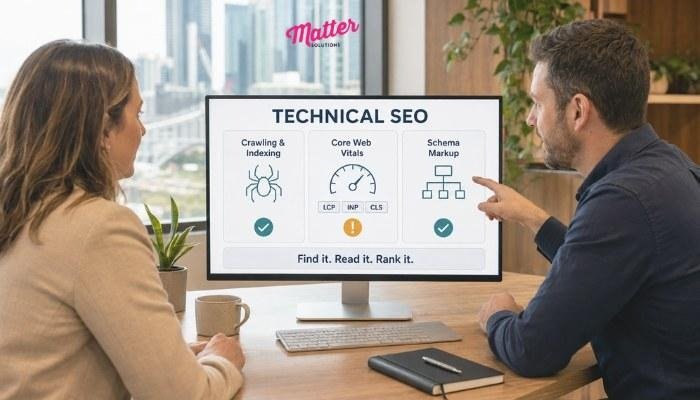
A technically sound website gives search engines everything they need to find it, read it, and rank it. For Brisbane small business owners, that’s the difference between content that drives more organic traffic vs one that sits idle.
These areas cover most of what technical SEO involves for a small business site.
Crawling and Indexing: Using Google Search Console as a Tool
Googlebot has to crawl a page before it can appear in search engine results. In this case, Google Search Console shows exactly which pages search engines can and can’t access. So it’s the first SEO tool worth opening when technical issues surface.
In general, broken links, missing sitemaps, and noindex tags on the wrong pages all block Google from reading content it should rank (and the pages look perfectly fine from the front end). Even one misconfigured robots.txt file can stop Googlebot from reading entire sections of a site. And that includes pages your target audience needs to find.
Core Web Vitals and Site Speed: The Numbers Google Checks
Think about it this way: every second a page takes to load on mobile devices is a second a potential local customer spends deciding whether to stay or leave. Google measures this through Core Web Vitals. These are three signals that track page load time, visual stability, and responsiveness on real user devices.
LCP, INP, and CLS are the specific metrics, and each has a pass threshold. Among them, website and page speed are confirmed ranking factors. Basically, poor scores don’t just hurt user experience (that lost enquiry rarely comes back). They also pull down search engine visibility and make significant improvements harder to hold onto.
Schema Markup: Helping Google Understand Your Business
Schema markup is structured data that helps search engines understand exactly what a business does, where it operates, and what it offers. Time and again, our audits show that LocalBusiness schema is the last thing anyone thinks to check, despite sitting right alongside meta tags and page titles as a foundational task.
For local SEO, it directly influences geographic search results and makes a business eligible for rich results in Google Business Profile listings. Once it’s in place, it lets you optimise on-page elements with much more precision and helps search engines understand your full service offering.
What Brisbane Businesses Should Fix First
Most business owners know something is off with their site but don’t know where to start. And that confusion is exactly where rankings stall. After working with Brisbane businesses for over 25 years, we’ve seen that a short list of high-impact technical SEO audits is the fastest path forward.
The table below will explain the recommended audit, each tied to a free SEO tool:
| Technical Issue | Why It’s Necessary | Free Tool to Use |
| Pages not indexed | Content stays invisible in search engine results | Google Search Console |
| Slow load time | Increases bounce rate, lowers rankings | Google PageSpeed Insights |
| Poor mobile usability | Hurts mobile-first indexing | Google PageSpeed Insights |
| Missing schema markup | Loses rich result eligibility | Google Rich Results Test |
| Duplicate content | Splits ranking signals across pages | Screaming Frog (free, up to 500 URLs) |
Quick Tip: Running these same SEO tools on a competitor’s URL is one of the sharpest moves a Brisbane business can make.
Especially in highly competitive industries like professional services, trades, and legal, a competitor analysis often reveals target keywords your SEO specialists haven’t addressed yet. It can also disclose relevant keyword opportunities that may help expand your search visibility.
That’s how local businesses identify SEO issues early, fix ranking problems, and protect their organic traffic before search visibility starts to decline.
See also: The Future of Intelligent Business Systems
Stop Losing Ground to Technical SEO Problems
Technical SEO is the foundation that decides whether your content, Google Ads, and broader digital marketing efforts perform the way they should. AI search and generative engine optimisation are raising the bar even further. Unfortunately, for Australian businesses trying to create content that reaches the right people, that gap widens every month.
Our specialists at Matter Solutions have delivered technical audits, local SEO strategies, and full engine optimisation campaigns for Australian businesses since 2000. If your site isn’t generating more organic traffic or hitting its search engine rankings, we can find out why.
Reach out and browse our other articles for more on SEO services, Google Ads, and digital marketing strategies built around real business objectives and your target audience.